Showing posts with label exotic travel. Show all posts

Tuesday, January 31, 2012

What Do Deer, Buddha, and a Wooden Temple have in Common?

All three are located in the historic city of Nara, Japan and all three are tourist destinations.  Yes, even the deer.  The deer are considered sacred messengers of the gods in the Shinto religion so are found nearly everywhere in this sacred city, many waiting for a handout from willing tourists. 

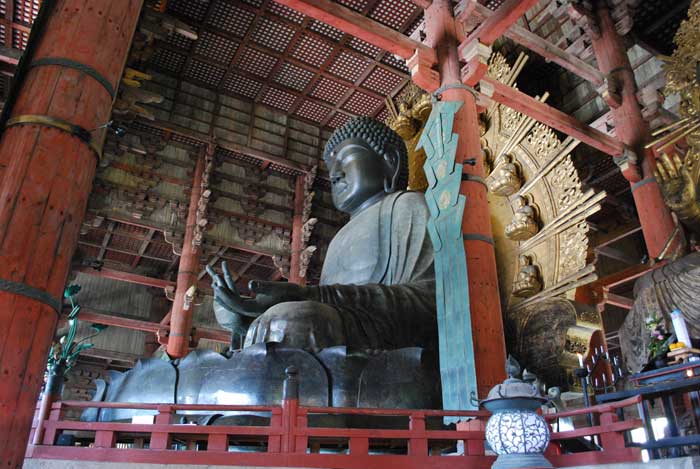
The Sika deer roam the huge park which contains temples and museums aplenty as well as the largest wooden structure in the world, the Todaiji Temple.  The Temple first built in the early 700s was actually more grand then the existing Temple of 1709.  (The current building was finished in 1709, and although immense—57 m long and 50 m wide—it is actually 30% smaller than its predecessor. Nevertheless, the Daibutsuden is considered the largest building in the world made primarily of wood.)

As if the deer and the largest wooden structure in the world aren't enough, there's more.  The Todaiji Temple houses the world's largest bronze statue of the Buddha Vairocana!  This 52 foot high statue was completed in 751 AD after three years of casting work.  Documentation states that over 2,6000,000 people worked on the immense temple and Buddha, and that the project nearly bankrupted Japan's economy, consuming most of the available bronze of the time.

And those sacred Sika deer of Nara?
"On our way to the shrine, many deer appeared in the morning darkness. This is a sign from the gods and a good omen. People say that when one encounters deer, he or she should get out of the carriage and bow to them."
— From Gyokuyo by Kujo Kanezane of the 12th century

Monday, January 16, 2012

You Will See the Church

"Walk to the train station in Copenhagen; take the train to a town one hour west of the city; catch the bus to the village; get off at the F5 stop and you can see the church.  The sexton will meet you there."  No problem.  Trains and buses--the transportation of Europe.  Perfect!

The train ride from Copenhagen was uneventful.  We got off the train in a tiny station to catch the local bus.  The bus wound its way through the picturesque village and into the countryside.  Home became more sparse and the happily grazing cows more common.  When our stop, F5, was announced, we alighted at what appeared to be a crossroads of two local roads at best and two farm lanes at most.  "Get off the bus at stop F5 and you will see the church" were the directions.

We stepped off the bus, expecting a church building to have miraculously appeared at the crossroads'  however, there seemed to be no church in sight.  Was this the right stop?

Yes, there it was --a simple white-steepled church set in a lush pasture of gently waving grass a half mile or so away.  A narrow paved road wound its way past the contented cows to the perfectly quiet, perfectly serene, perfectly perfect little Danish church--unimposing in its welcome, unpretentious in its simple reflection of God's glory!

Saturday, January 14, 2012

Raw Octopus or Zwiebel mit Speck

After concert parties and receptions are a time to relax and get to know fellow organists and music-lovers--a time to sample the culture--a time to suspend language barriers--a time to laugh and make lasting memories--and a time to share unique and unimaginable foods.

I recall my first taste of caviar in an Austrian town hall;  raw eggs, fish and even octopus (no, it did not stick to my tongue but it sure was hard to swallow) in Tokyo; zwiebel mit speck (intense onion and barely cooked bacon) in a Hungarian village;  dried fish blood curry (a Sri Lankan specialty);  tea, strong tea and even stronger tea (a given in Zimbabwe--or was that Sri Lanka or England or Australia or New Zealand).

I remember my first and probably the best chai ever at a resort in Sigiriya, Sri Lanka, just after the boa constrictor and cobra show (were those snakes really crawling around under the chairs?);  cream, cream, and more cream (even the ice cream was covered in cream) in Bulawayo, Zimbabwe;  Kobe beef (the specialty of a French restaurant) in Tokyo where choosing which fork to use and how to use it was a challenge for our Japanese hosts.

Music, friends, food--life!

Thursday, January 12, 2012

The Indian Ocean and The Elephant

Walking the pristine beach near Galle, Sri Lanka one hot sunny afternoon, my friends and I happened upon a man and his "working" elephant.  We managed to communicate with various signs and a few words that if I would buy several bananas for his elephant, he would let me ride this magnificent creature.

Eagerly I bought a huge bunch of bananas, ensuring a long ride on this gigantic but somehow contented and kind looking animal.  The elephant's owner patiently showed me how to climb aboard his charge.

Awkwardly and not the least bit gracefully, this very white woman in a brightly colored swimsuit made her way to the heights of the gentle elephant.  Sitting directly behind its ears and hanging on for dear life, the elephant and I, with encouragement from his keeper began our adventure.  We made our way down the beach and out into the ocean and back to the beach, stopping only when the rough trunk reached back to remind me that he was in the rather embarrassing situation (of having a gangly-legged woman perched on his back) for only one reason--another tasty banana.  Up close and personal with "my" elephant!

Thursday, January 5, 2012

The Presipio and the Gato

Having always loved nativity scenes, Rome turned out to be the "place to be" during this Christmas and Epiphany season as Italians also love their presipi, or nativity displays.  It is said that the presipio originated in Italy in the 1200′s when St. Francis of Assisi asked Giovanni Vellita from the village of Greccio to create a manger scene. St. Francis then performed Christmas mass in front of this nativity scene. 
Italy is an especially historic and interesting country, and no city is greater in historical significance than Rome.  It is to Rome that I traveled one year during the Twelve Days of Christmas which culminated with the celebration of Epiphany.  It was a glorious time to be in Rome. 


In 17th century Naples, artisans began creating presipi and made the creation of nativity scenes into an art form. The presepi included the nativity scene but also represented life in Naples at the time. Today many artisans are still dedicated to the craft of creating hand made figures for presepi. 

presepe photoDozens if not hundreds of elaborate presipi are on display in Rome during the Christmas and Epiphany seasons.  These presipi, some centuries-old, are located in churches, museums, storefronts, and homes.  A shooting star symbol indicates a building in which a presipio can be found.  And what a treasure they are!

Besides the usual ten figures Americans generally think of in a nativity scene, Mary, Joseph, the baby Jesus, the three wise men, a shepherd and a few animals, in Italy the presepio (manger scene), contains large numbers of biblical characters, angels, animals and people from every day life as well.  The presipi are large--some taking up entire rooms--and intricate.  It is a thrill to actually discover the "inn" with the baby Jesus in each presipio.  It is sort of a "where's Waldo" type moment.

On the day of Epiphany, my host and I traveled through the labyrinth of Roman streets to look one more time at the presipi.  Why?  Because each presipio had changed overnight.  You see, the kings "had arrived" during the night bearing their gifts for the Christ child.  Three more gloriously carved figures, their camels, and their entourage had been added to each presipio. 

What an incredible treasure these presipio are for the local and tourist to Rome during the Christmas and Epiphany seasons! 

Oh, I nearly forgot to mention the "gato"!  There were gato--or cats--simply everywhere you looked in Rome--more numerous than the presipi.

Sunday, January 1, 2012

The Colors of Koi

A weariness that only 36 hours of travel can bring had descended upon my body.  I was ready for only one thing--sleep!  However, my hosts had a different plan.  It was early afternoon and they knew that sleep was the last thing I should have at that moment if I was to become quickly acclimated to a time zone a mere ten hours earlier than what I had left. 

Instead of a rest on a tatami mat spread on a wood floor, I was instead given the back seat in a tiny van headed for yet another train station.  Arriving at the train platform standing high above the rice paddies, we boarded a high speed train for the mountains towering above Kanagawa, Japan.  Speeding along the train rocked so severely that sleep again was impossible.  After all, if I stayed awake I might just glimpse Mt. Fuji in the distance.

An hour later we were whisked off the train in the gathering dusk to climb aboard yet another small van.  The van this time took us not through conjested city streets, but along curving roads high into the mountains.  The goal of this afternoon of travel was to arrive at a place of peace, calm, gentleness and relaxation -- the Hakone hot springs spa in the heart of Japan. 

Stepping from the van, all the weariness of travel slowly began to disappear.  Koi lazily swam through the crystal clear pools lining the pathway to the hot springs-- their stark white, shimmering silver and gold, and bold orange colors vibrant against the backdrop of black rock and the dark green foliage.  These fish provided the perfect example for experiencing the hot springs--slowly and with deliberate calm. 

From hot soaking pools to plunges in cold water to letting the warm waters of a hot spring waterfall cascade over the body; to sitting with eyes closed soaking up the warm steam in the sauna to drifting lazily across a crytal clear pool on an air matress; to concluding green tea served in a koi-pool surrounded tea house, my first evening in Japan was pure magic. 

I was ready to stay at Hakone for the entire month of our visit, yet, I knew there were other treasures to behold and experiences to be had in Japan. 

Friday, December 30, 2011

Bells Ring! Are You Listenin'?


Alps.  Villages.  Cows.  Churches.  Bells.  Ski lifts.  Switzerland!

I love the sound of bells--from the least to the greatest.  On a trip to Switzerland, I the "bell experience" of a lifetime. 

The preferred mode of transportation on this particular trip to Switzerland was by train.  High speed trains zipped us through the Alps (literally) from Italy;  took us around lakes;  to the modern cities;  through picturesque countryside;  and eventually to the end of the train line in the high mountain village of Engleberg.  
Alighting from the gentle old train that had crawled its way up the slopes to Engleberg, we were greeted by a tranquil mountain village complete with steep cobblestone streets, a village market, the Abbey church, and most incredibly the cacophony of bells.                                                  

It was nearing the noon hour and the grand bells of the Abbey Church were calling the monks to noon prayer.  These great bells were only the accompaniment to a continuous overlay of the sound of various other bells--those that tinkled, those that clonked, those that chimed, and those that thwacked.  These were the bells hung around the necks of the local livestock from frisky goats to brown-eyed Swiss cows.  What a
glorious cacophony! 

Coming from Portland, Oregon we had specifically chosen to visit the village of Engleberg because of its relation to a small Oregon village called Mt. Angel.  You see, a hundred years earlier, a group of monks from the Engleberg Abbey had left their Swiss mountain retreat to found a new Abbey in the United States.  The monks chose the picturesque Willamette Valley for their new home.  On the highest spot they could find in this valley, they built their abbey.  Mt. Angel in St. Benedict, Oregon doesn't reside in the mountains --although majestic Mt. Hood can be seen from "the hill" as the abbey's home is called--but is among majestic Douglas fir stands.  Panoramic of the Mt Angel Abbey Chappel. Mt Angel Oregon

Possibly these trees reminded those first monks of their Swiss home.  Anyway, we decided to visit the home of the founders of Mt. Angel--the Abbey of Engleberg (in English Mt. Angel).
On our second day in this idyllic setting, it was decided that a trip up the slopes of the local Mt. Titlis via a ski lift was in order.  Being summer, the alpine wildflowers were in full bloom and the views of the village from above were said to be breathtaking.

Patiently waiting my turn to grab a seat on the lift as the chairs rounded the lift pick-up area, I noticed that things were getting hazy.  By the time, I was safely seated on the lift, a cloud had surrounded the lift hut.  As the chair swung out over the lip of the hut, suddenly everything was obscured by the cloud.  No other chairs on the lift could be seen in front or behind.  The lift hut was gone.  The chalets has disappeared.  The cows and goats were no longer there.  And amazingly the majestic steeple and bell tower of the Abbey Church was obscured.

Suddenly it was also nearly shockingly quiet!  With feet dangling over an abyss only imagined, and everything in sight a dull gray, I became aware of the sense of sound.  And what a glory it was.

Bells, bells, and more bells!  First a melodious tinkle--a goat in a pasture below?  A deep clonk--a brown Swiss cow wandering about in the fog?  A gentle chime--was that a wind chime on a chalet?  A thudding thwack--another brown-eyed long-lashed cow?   and then the insistent pealing of a low booming bell--calling the monks to Vespers?  A more awesome cacophony I have never heard since!
x